Culture & History · 4 min read
Llanito and Coast-Speak: Where English and Spanish Blur
Gibraltar's Llanito, Spanglish menus and English place names: how two languages share one coastline.
Costa Del Sol Unlocked · November 2026
You do not need to look far on this coast to realise that language is a fluid, practical thing rather than a rigid set of rules. From the tip of the Rock to the eastern edge of the Axarquía, the way we speak is defined by the proximity of two nations that have spent centuries rubbing shoulders, arguing, and eventually settling into a comfortable, if messy, linguistic hybrid.
The mechanics of Llanito
Llanito is the everyday speech of Gibraltar, and it is a fascinating, unselfconscious collision of Spanish grammar and English vocabulary. It is not a textbook language, nor is it merely a dialect; it is a rapid-fire necessity shaped by the unique position of the Rock. A local might start a sentence in Spanish, pivot to an English technical term, and finish with a Spanish idiom, all without changing their tone or pace.
You will hear this mostly in the street or among friends, where the words flow exactly as the speaker requires them to. It sounds like a frantic mix, but to the locals, it is just efficiency. Historically, this grew from the garrison, the port, and the thousands of families who moved across the border daily to work before the frontier was closed for those long, quiet years in the mid-twentieth century. Even when the physical gates were locked, the patterns of speech had already been baked into the population.
Language on the move
Outside of Gibraltar, the coastline tells a different story, one of pragmatism and tourism. In places like Málaga or Torrox, you find a coast that has been colonised not by armies, but by economies. You will see menus in three languages, not because the establishment is trying to be cosmopolitan, but because a waiter needs to explain a grilled sea bass to a German tourist, a British expat, and a local family all within the same hour.
This has led to a sort of 'Coast-Speak' that is less about grammar and more about the path of least resistance. You might walk into a shop in Estepona and hear the owner switch from perfect, rapid-fire Andalusian Spanish to polite, slightly formal English in a single breath. They are not performing for you; they are simply matching their output to the person standing in front of them.
A shared history of borderlands
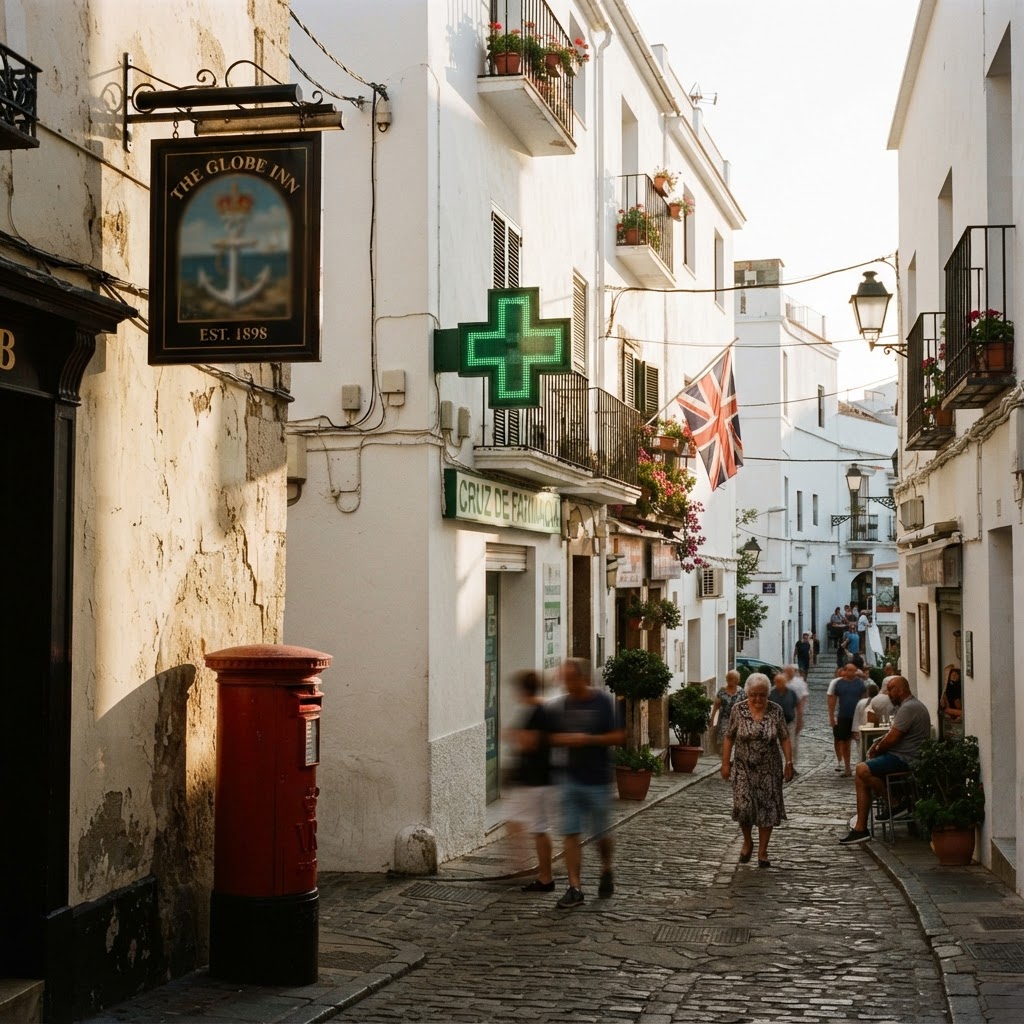
The history of this area is one of constant movement. For generations, the white villages in the mountains around Ronda or Frigiliana served as the interior, while the coast was a place of trade and defence. When the British influence grew, it did not replace the local culture; it was grafted onto it. That is why you find pubs, chip shops, and English newspapers sitting comfortably alongside the traditional Spanish chiringuito.
There is no shame in this hybridity. It is a record of how people have survived here: by adapting. During the decades when the border with Gibraltar was shut, the dependency did not vanish; it moved underground, into trade and family connections. Now that the movement is freer, the linguistic mixing continues as the younger generations navigate a coast that is inherently international.
Language is not a museum piece on the Costa del Sol. It is a tool for selling houses, fixing cars, and buying bread, and it works best when it is unpretentious and ready to change at a moment's notice.
How to handle the mix
If you are visiting, do not worry too much about getting the balance right. The locals are far more interested in whether you want your coffee with milk or water than whether your Spanish is grammatically perfect. The culture of this coast is built on letting people be themselves, and that extends to how they express their thoughts.
- Attempting a few basic Spanish greetings is always appreciated, even if the response comes back in English.
- Expect to encounter menus that misinterpret English phrases; point them out kindly or just order the food and enjoy it.
- Do not be surprised if a conversation starts in one language and ends in another.
- If you are unsure if someone speaks English, ask simply and clearly.
- Check locally if you find yourself struggling with signage or directions, as a quick conversation with a barman is often more accurate than any digital translation.
Ultimately, you should accept both the English and the Spanish for what they are: working languages. Neither is the wrong answer, and neither needs to be defended. Just pay attention to the rhythm of the place you are in, and you will find that you can get by with just a little bit of patience and a willingness to be understood.
Keep reading